
4TY_wgMLST
Introduction
4TY_wgMLST performs in silico "whole genome Multi-Locus Sequence Typing" (wgMLST) for the bacterial species Campylobacter jejuni and Campylobacter coli. Unlike the cgMLST (core genome MLST) protocol, characterization is performed on the whole genome.

Run 4TY_wgMLST analysis
Once the analysis 4TY_wgMLST has been selected in the dedicated run analyses page, it will be possible to choose the bioinformatics software ("method") to use, among those available for the analysis. The only method available for this analysis is chewBBACA - BSR-Based Allele Calling Algorithm.
Note: wgMLST schemas are available only for Campylobacter jejuni and Campylobacter coli. Running the analysis on another microorganism, for which no wgMLST schema is available, will cause the run to fail.
The input selection interface provides the advanced input selection mode, to allow the use of inputs processed by different methods that were applied upstream in the analysis workflow.
Accepted inputs can originate from:
- step_2MG_denovo
- step_2AS_denovo
- step_2AS_mapping
- step_2AS_import
It will be necessary to specify the input sequences - whether derived from de novo assembly or from mapping - and the reference genome used for mapping, if the latter is selected as input.
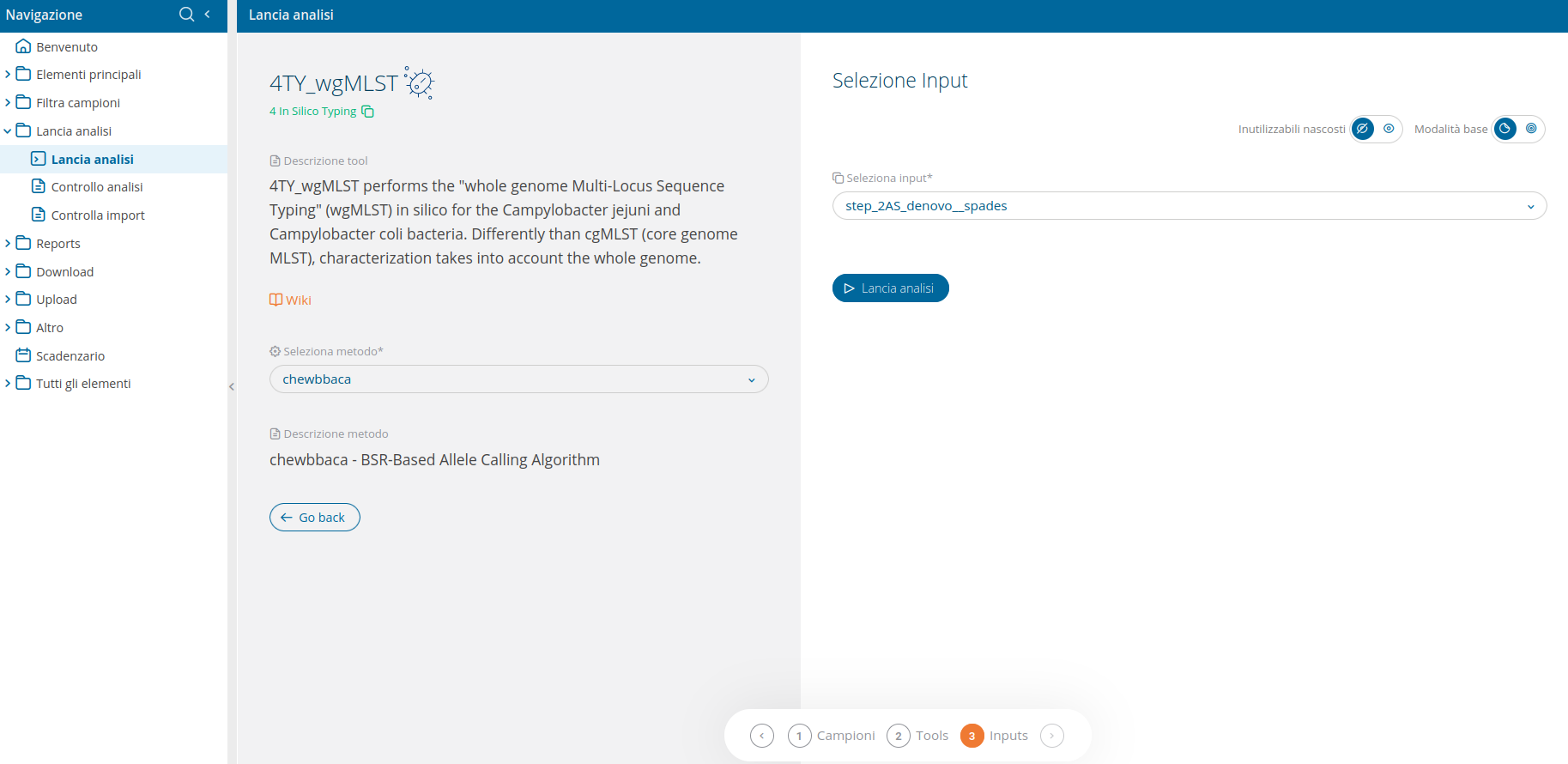
Once the analysis is launched, the page generates a link to the Check analysis section to allow a check of the processus status. The system will send the user a notification both when the analysis is successfully started and when the operation is completed.
Result folder
To consult the guide on how to download files from the platform, please refer to the dedicated page.
The Result folder can be browsed by clicking the link available within the analysis card, in the Result data section. Inside the subsequent results folder, there are 3 subfolders:
- meta: (metadata), where the log and configuration files of the executed process are saved;
- qc: (quality check), where quality check files are saved. It also contains the two subfolders meta and result. For this analysis, quality check is performed with Quast;
- result: where the files containing the results produced by the analysis are saved.
For allele calling with chewBBACA, results are provided using three different schemas:
- IZS schema: each allele is identified by a progressive numeric ID. ID assignment considers all loci, therefore numbering does NOT restart from 1 for each new locus.
- MD5 schema: each allele is identified by a 16-character alphanumeric code (MD5), obtained by applying a hash function to the allele sequence; this makes it interchangeable with other methods.
- CRC32 schema: control based on Cyclic Redundancy Check (CRC). Each allele is assigned a numeric check value determined by the remainder of the polynomial division of the data block. This value is used in the schema as the allele identifier.
Please note that the example file "DSXXXXXXXX-DTXXXXXX_ID_chewbbaca_results_ccoli_curated_210722.csv" shown in the table below can have a suffix for C. coli or C. jejuni, depending on the analyzed species.
| File | Description | Location |
|---|---|---|
| DSXXXXXXXX-DTXXXXXX_ID_chewbbaca_new_alleles.txt | sequence of newly-identified alleles | folder: result |
| DSXXXXXXXX-DTXXXXXX_ID_chewbbaca_results_contigsInfo.tsv | info about the contig mapped on each locus | folder: result |
| DSXXXXXXXX-DTXXXXXX_ID_chewbbaca_results_statistics.tsv | metrics on loci encoded as EXC, INF, LNF, PLOT, NIPH, ALM, ASM | folder: result |
| DSXXXXXXXX-DTXXXXXX_ID_import_chewbbaca_check.csv | quality check with info on calledPerc, calledNum, annotated, new, notFound, discarded | folder: qc > result |
| DSXXXXXXXX-DTXXXXXX_ID_chewbbaca_results_crc32.csv | .csv table of alleles encoded with CRC32 schema. Rows: samples, columns: loci | folder: result |
For more information on locus encoding and on chewBBACA output files, please refer to chewBBACA official guide.