
4AN_AMR
Introduction
4AN_AMR (Anti-Microbial Resistance) predicts the presence of genes related to antimicrobial resistance and virulence genes, in the reconstructed sequence of the microorganism of interest.

Run 4AN_AMR analysis
Once the analysis 4AN_AMR has been selected in the dedicated run analyses page, it will be possible to choose the bioinformatics software ("method") to use, among those available for the analysis. The available tools in this case are:
For all microorganisms:
-
ABRicate - Mass screening of contigs for antimicrobial resistance or virulence genes.
ABRicate GitHub page: https://github.com/tseemann/abricate
-
AMRFinderPlus - AMRFinderPlus identifies acquired antimicrobial resistance genes in bacterial protein and/or assembled nucleotide sequences as well as known resistance-associated point mutations for several taxa.
AMRFinderPlus GitHub page: https://github.com/ncbi/amr/wiki/Running-AMRFinderPlus#usage
-
ResFinder - identification of acquired antimicrobial resistance genes.
ResFinder GitHub page: https://github.com/cadms/resfinder
-
PlasmidFinder - gene identification for the identification and typing of plasmids.
PlasmidFinder GitHub page: https://github.com/genomicepidemiology/plasmidfinder
For Klebsiella pneumoniae (but also for K. oxytoca and Escherichia genus):
- Kleborate - a tool to screen genome assemblies of Klebsiella pneumoniae and the Klebsiella pneumoniae species complex (KpSC).
Kleborate GitHub page: https://kleborate.readthedocs.io/en/latest/Usage.html
For Escherichia coli only:
- patho_typing - identification of acquired antimicrobial resistance genes.
Patho_typing GitHub page: https://github.com/B-UMMI/patho_typing
For Staphylococcus aureus only:
- BLAST - the Basic Local Alignment Search Tool finds regions of similarity between biological sequences.
BLAST GitHub page: https://github.com/ncbi/blast_plus_docs
For Campylobacter only:
- staramr - (*AMR) compiles a summary report of detected antimicrobial resistance genes.
staramr GitHub page: https://github.com/phac-nml/staramr
For 4AN_AMR it is necessary to specify the input sequences - whether derived from de novo assembly or from mapping - and the reference genome used for mapping, if the latter is selected as input.
The input selection interface provides the advanced input selection mode, to allow the use of inputs processed by different methods that were applied upstream in the analysis workflow.
Accepted inputs can originate from:
- step_2AS_mapping
- step_2AS_denovo
- step_2MG_denovo
- step_2AS_import
Note: in addition to the tools for the Anti-Microbial Resistance investigation, the available tools also include "Filtering" which does not run AMR: it filters AMR results (performed with one of the other available programs) on the base of the specified coverage and identity parameters. The usable inputs are step_3TX_species__vdabricate and step_4AN_AMR__abricate.
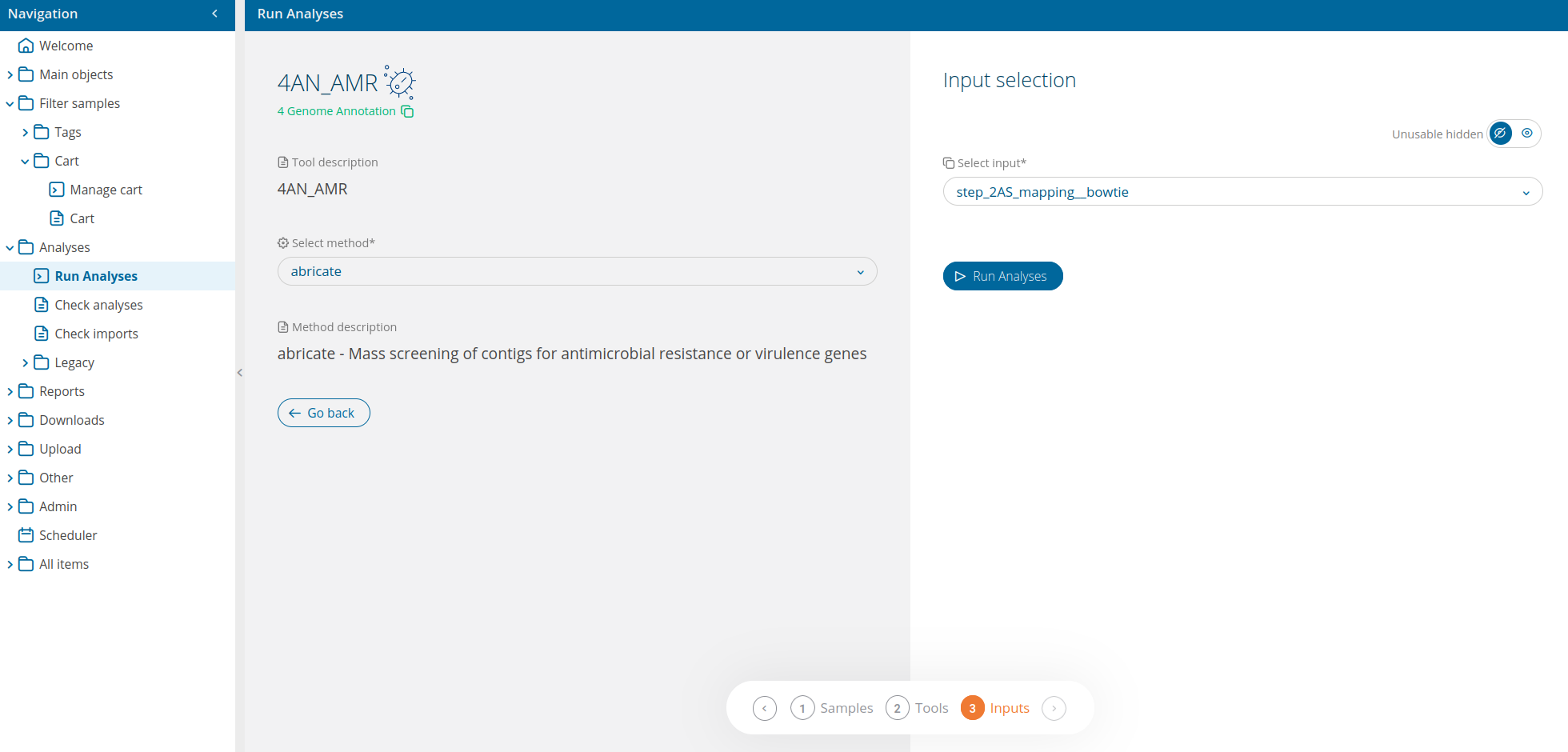
Once the analysis is launched, the page generates a link to the Check analysis section to allow a check of the processus status. The system will send the user a notification both when the analysis is successfully started and when the operation is completed.
Result folder
To consult the guide on how to download files from the platform, please refer to the dedicated page.
The Result folder can be browsed by clicking the link available within the analysis card, in the Result data section. Inside the subsequent results folder, there are 2 subfolders:
- meta: (metadata), where the log and configuration files of the executed process are saved;
- result: where the files containing the results produced by the analysis are saved.
The tables below show the lists of files present in the folders, along with some useful information.
ABRicate
| File | Description | Location |
|---|---|---|
| DSXXXXXXXX-DTXXXXXX_ID_abricate_calls.txt | file with gene alignment results, coverage and database queries | folder: results |
| DSXXXXXXXX-DTXXXXXX_ID_abricate.summary | ABRicate summary file containing genes and their coverage | folder: results |
| DSXXXXXXXX-DTXXXXXX_ID_output_abricate_AMR.csv | antibiotic resistance genes summary file | folder: results |
| DSXXXXXXXX-DTXXXXXX_ID_output_abricate_VF.csv | virulence genes summary file | folder: results |
For further details regarding the files generated by ABRicate, please refer to the official manual of ABRicate.
BLAST
| File | Description | Location |
|---|---|---|
| DSXXXXXXXX-DTXXXXXX_ID_blast_out.tsv | .tsv table containing BLAST results | folder: results |
staramr
| File | Description | Location |
|---|---|---|
| DSXXXXXXXX-DTXXXXXX_ID_staramr_detailed_summary.tsv | .tsv table of results organized by data type (resistance gene/plasmid/MLST scheme...) | folder: results |
| DSXXXXXXXX-DTXXXXXX_ID_staramr_mlst.tsv | results of the 7-loci MLST scheme for species-specific genes + Sequence Type (ST) | folder: results |
| DSXXXXXXXX-DTXXXXXX_ID_staramr_plasmidfinder.tsv | .tsv results with sequences belonging to identified plasmids | folder: results |
| DSXXXXXXXX-DTXXXXXX_ID_staramr_pointfinder.tsv | AMR results in .tsv format with Pointfinder position | folder: results |
| DSXXXXXXXX-DTXXXXXX_ID_staramr_resfinder.tsv | resistance prediction results and resistance gene alignment | folder: results |
| DSXXXXXXXX-DTXXXXXX_ID_staramr_results.xlsx | AMR results in spreadsheet format | folder: results |
| DSXXXXXXXX-DTXXXXXX_ID_staramr_summary.tsv | AMR results in .tsv format | folder: results |
ResFinder
| File | Description | Location |
|---|---|---|
| DSXXXXXXXX-DTXXXXXX_ID_resfinder_ResFinder_Hit_in_genome_seq.fsa | fasta file with the sequence of the resistance gene(s) identified in the sample genome with extended header | folder: results |
| DSXXXXXXXX-DTXXXXXX_ID_resfinder_ResFinder_Resistance_gene_seq.fsa | fasta file with the sequence of the resistance gene(s) identified in the sample genome with reduced header | folder: results |
| DSXXXXXXXX-DTXXXXXX_ID_resfinder_ResFinder_results.txt | text file with summary table and sequence identity | folder: results |
| DSXXXXXXXX-DTXXXXXX_ID_resfinder_ResFinder_results_tab.txt | .tsv file with the list of identified resistance genes (it lists only the genes that are present) | folder: results |
| DSXXXXXXXX-DTXXXXXX_ID_resfinder_ResFinder_results_table.txt | text file with the list of resistance genes (it specifies both the genes that are present and those that were not detected) | folder: results |
| DSXXXXXXXX-DTXXXXXX_ID_resfinder_pheno_table.txt | text file with results and phenotypes table | folder: results |
| DSXXXXXXXX-DTXXXXXX_ID_resfinder_std_format_under_development.json | folder: results |
AMRFinderPlus
| File | Description | Location |
|---|---|---|
| DSXXXXXXXX-DTXXXXXX_ID_amrfinderplus.tsv | .tsv table with information on the identified resistance genes | folder: result |
kleborate
| File | Description | Location |
|---|---|---|
| DSXXXXXXXX-DTXXXXXX_kleborate.tsv | .tsv table containing all typing results | folder: result |
Patho_typing
| File | Description | Location |
|---|---|---|
| DSXXXXXXXX-DTXXXXXX_patho_typing_rematchModule_report.txt | .tsv table containing information on genes identified by ReMatCh | folder: result |
| DSXXXXXXXX-DTXXXXXX_patho_typing_report.txt | .tsv table containing the possible pathotypes identified | folder: result |
| DSXXXXXXXX-DTXXXXXX_patho_typing_extended_report.txt | .tsv table containing information on the genes identified for pathotype attribution | folder: result |
plasmidfinder
| File | Description | Location |
|---|---|---|
| DSXXXXXXXX-DTXXXXXX_plasmidfinder_results.tsv | .tsv table containig information on the identified plasmids | folder: result |
| DSXXXXXXXX-DTXXXXXX_plasmidfinder_kma_*.res/aln/fsa | kma results for the identified plasmids | folder: result |