
4TY_cgMLST
Introduction
4TY_cgMLST performs the "core genome Multi-Locus Sequence Typing" (cgMLST), a bacterial isolate characterization protocol, which allows identification of clones in microbial population.

Run 4TY_cgMLST analysis
Once the analysis 4TY_cgMLST has been selected in the dedicated run analyses page, it will be possible to choose the bioinformatics software ("method") to use, among those available for the analysis. The available tool in this case is chewBBACA - BSR-Based Allele Calling Algorithm.
chewBBACA GitHub page: https://github.com/B-UMMI/chewBBACA
In the table below, the available schemes for the supported microorganisms are listed.
| Species | Scheme name | Number of loci | Date of last update |
|---|---|---|---|
| Mycobacterium bovis | m_bovis_2891_230720 |
2891 | 20/07/2023 |
| Listeria monocytogenes | l_mono_chewie_1748_220623 |
1748 | 23/06/2022 |
| Campylobacter jejuni | c_jejuni_678_180728 |
678 | 28/07/2018 |
| Campylobacter coli | c_coli_528_220722 |
528 | 22/07/2022 |
| Staphylococcus aureus | s_aureus_ridom_1861_210617 |
1861 | 17/06/2021 |
| Brucella melitensis | b_melitensis_bme_2584_211118 |
2584 | 18/11/2021 |
| Klebsiella pneumoniae | k_pneumoniae_pasteur_629_250617 |
629 | 17/06/2025 |
| Klebsiella pneumoniae | k_pneumoniae_pasteur_2759_250617 |
2759 | 17/06/2025 |
| Escherichia coli | e_coli_chewie_2360_210531 |
2360 | 31/05/2021 |
| Salmonella enterica | s_enterica_chewie_3255_210531 |
3255 | 31/05/2021 |
| Brucella spp. | b_wide_1764_220709 |
1764 | 09/07/2022 |
| Bacillus anthracis | b_anthracis_pubmlst_3803_231214 |
3803 | 14/12/2023 |
| Acinetobacter baumannii | a_baumannii_ridom_2390_250612 |
2390 | 12/06/2025 |
| Pseudomonas aeruginosa | p_aeruginosa_ridom_3867_250612 |
3867 | 12/06/2025 |
| Serratia marcescens | s_marcescens_ridom_2692_250926 |
2692 | 26/09/2025 |
Note: Running 4TY_cgMLST on a microorganism for which no cgMLST scheme is available, will result in the run falling.
The input selection interface provides the advanced input selection mode, to allow the use of inputs processed by different methods that were applied upstream in the analysis workflow.
Accepted inputs can originate from:
- step_2MG_denovo
- step_2AS_denovo
- step_2AS_mapping
- step_2AS_import
It will be necessary to specify the input sequences - whether derived from de novo assembly or from mapping - and the reference genome used for mapping, if the latter is selected as input.
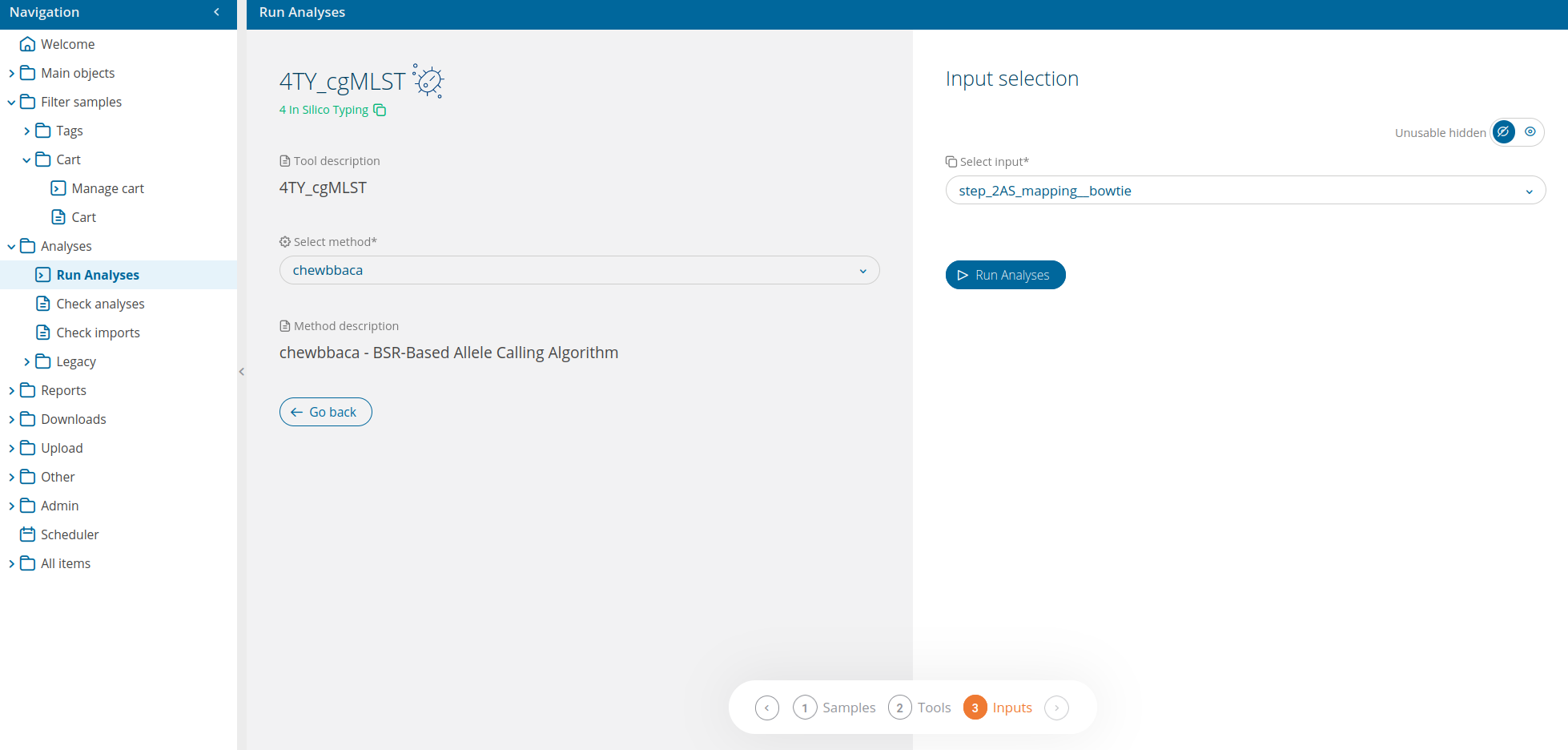
Once the analysis is launched, the page generates a link to the Check analysis section to allow a check of the processus status. The system will send the user a notification both when the analysis is successfully started and when the operation is completed.
Result folder
To consult the guide on how to download files from the platform, please refer to the dedicated page.
The Result folder can be browsed by clicking the link available within the analysis card, in the Result data section. Inside the subsequent results folder, there are 3 subfolders:
- meta: (metadata), where the log and configuration files of the executed process are saved;
- qc: (quality check), where quality check files are saved;
- result: where the files containing the results produced by the analysis are saved.
For allele calling with chewBBACA, the results will be provided using crc32 encoding (link to crc32 on Wikipedia).
| File | Description | Location |
|---|---|---|
| DSXXXXXXXX-DTXXXXXX_ID_chewbbaca_new_alleles.txt | sequences of newly-identified alleles | folder: result |
| DSXXXXXXXX-DTXXXXXX_ID_chewbbaca_results_contigsInfo.tsv | info about the contig mapped on each locus | folder: result |
| DSXXXXXXXX-DTXXXXXX_ID_chewbbaca_results_statistics.tsv | statistics on loci encoded as EXC, INF, LNF, PLOT, NIPH, ALM, ASM | folder: result |
| DSXXXXXXXX-ID_import_chewbbaca_check.csv | quality check with info on calledPerc, calledNum, annotated, new, notFound, discarded | qc > result directory |
| DSXXXXXXXX-DTXXXXXX_ID_chewbbaca_results_crc32.tsv | chewBBACA allelic calls with crc32 encoding, in .tsv format | cartella "result" |
For more information on locus encoding and on chewBBACA output files, please refer to chewBBACA official guide.