
Genome Draft pipeline
Introduction
The Genome Draft pipeline is part of the Vdraft pipeline, also available separately. Genome Draft performs mapping of sequences (2AS_mapping) with both Bowtie2 and Snippy, followed by genome annotation (4AN_genes) using Prokka.
Genome annotation will only be executed on Snippy outputs and only if a file in genebank format (.gb or .gbk) has been used as reference; erence used, as a genebank, (.gb or .gbk) file format; in turn, Snippy can be executed only if the selected sample has the 4AN_genes analysis associated (Prokka).

Run Genome Draft pipeline
The filter at the top of the run analysis page allows to display only the pipelines. Once the Genome Draft pipeline has been selected, a confirmation interface will be displayed.
The Genome draft pipeline includes the following analyses:
- Mapping with Bowtie2 (2AS_mapping__bowtie);
- Mapping with Snippy (2AS_mapping__snippy);
- Genome annotation with Prokka (4AN_genes__prokka).
Both mapping runs also include the calculation of coverage.
The usable inputs are the outputs of pre-processing analyses:
- depleted reads (step_1PP_hostdepl);
- downsampled reads (step_1PP_downsampling);
- trimmed reads (step_1PP_trimming);
- filtered reads (step_1PP_filtering).
The input selection interface provides the advanced input selection mode, to allow the use of inputs processed by different methods that were applied upstream in the analysis workflow.
It will also be necessary to specify the genome of the host organism and a reference genome from those available, which will be used both for read mapping and for the functional annotation.
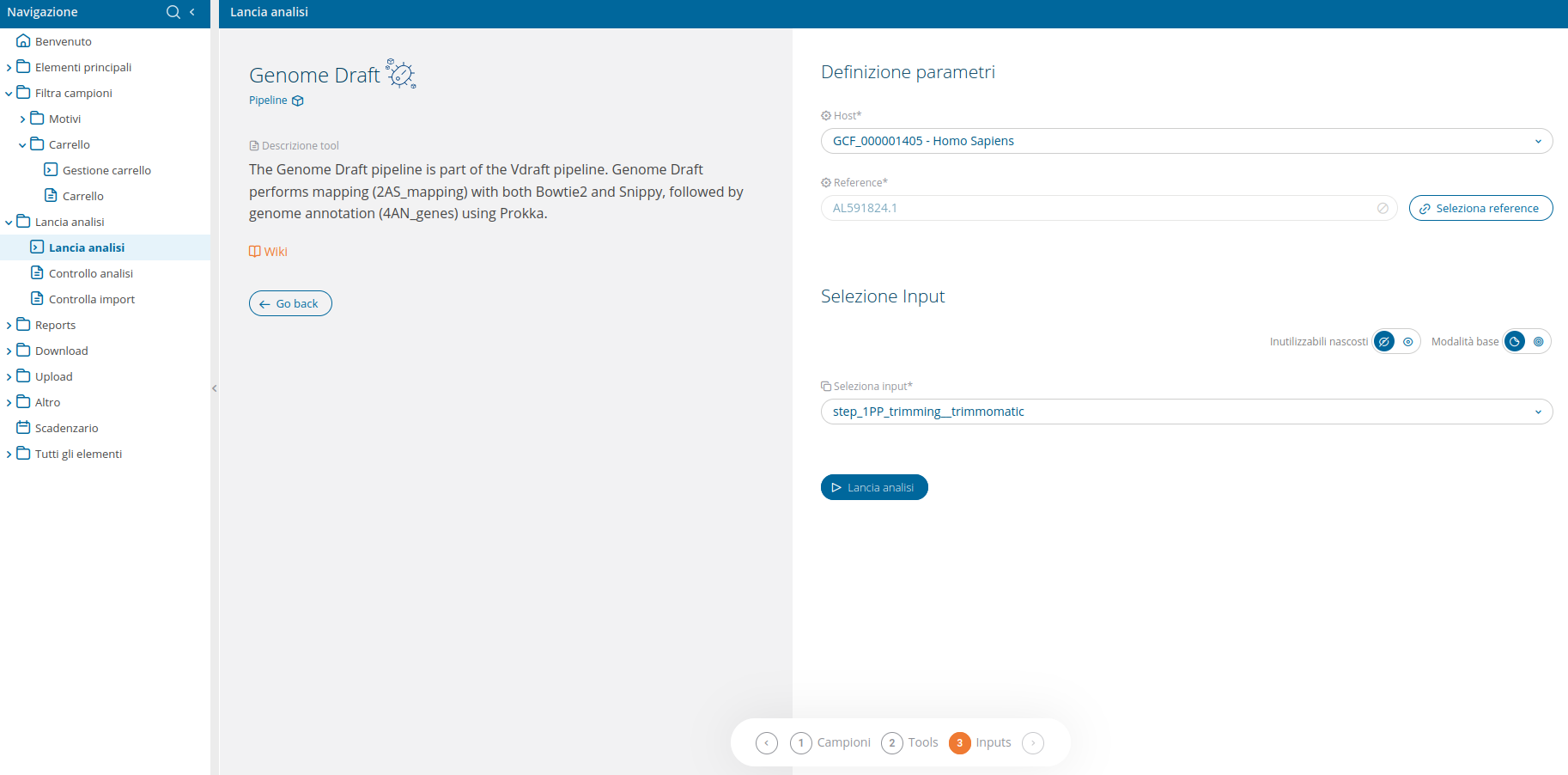
Once the pipeline is launched, the page generates a link to the Check analyses section to allow a check of the processus status. The user will be notified by the system both when the pipeline is successfully launched and when the operation is completed.
Results
Files generated by the "Genome draft" pipeline will be the same as those produced by the individual analyses that compose it, organized according the same hierarchy. As a reference, please refer to the relevant sections of the individual analyses: